
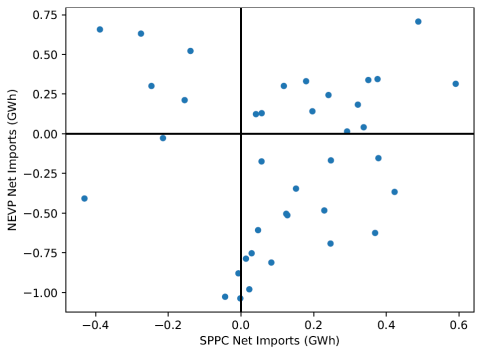
Storage Sizing GridView and Model Output Dataset

Dataset Image

download Download

Description

This dataset contains time series of output operational features from production cost simulations over historical weather conditions. Further, this dataset contains portfolios of energy storage, sized in relation to these operational outputs, using the storage sizing model available at link_to_storage_sizing_model. Datasets are presented with respect to the Western Interconnection of the US, on a zonal scale. Operational features are obtained from production cost simulations based on the Western Electricity Coordinating Council (WECC) 2032 Anchor Data Set (ADS), over weather conditions from 1982-2019.


For more details, please refer to data_paper_reference.


Corresponding author(s): Osten Anderson (osten.anderson@pnnl.gov) and Nathalie Voisin (nathalie.voisin@pnnl.gov)


Operational Time Series (GridView)

Each file contains an hourly time series over one year (8760 rows) of a particular operational feature, for each zone (columns). Scenario denotes the corresponding reference weather year (e.g. Y1982).

  1. curtailment_{scenario}.csv: Hourly energy curtailed in MWh
  2. import_limits_{scenario}.csv: Hourly limit on energy imports in MWh. Computed as the sum of incident transmission line thermal ratings.
  3. lmps_{scenario}.csv: Hourly locational marginal price in $/MWh.
  4. load_shed_{scenario}.csv: Hourly unserved energy in MWh.
  5. load_{scenario}.csv: Hourly energy demand in MWh.
  6. net_imports_{scenario}.csv: Hourly net imported energy in MWh. Positive denotes imports, negative denotes exports.


Storage Sizing Results

Each file contains outputs from the storage sizing model corresponding to one weather year. The storage sizing model takes several user-defined options, controlling the trajectory of storage costs and the availability of emerging storage technologies. This dataset considers just one potential combination, with midpoint (i.e. Point) costs and only currently commercialized (i.e. existing) technologies. Rows correspond to the results for each zone, with the last row (Total) being the sum of all other rows. Below are the descriptions of each column in the data:

  • {technology}_{duration}: Installed capacity of storage for given technology and duration combination in MW.
  • Total Charge Energy (MWh): Total energy charged by storage in MWh.
  • Total Discharge Energy (MWh): Total energy discharged by storage in MWh.
  • Total Bought Energy (MWh): Total energy purchased through the market approximation in MWh.
  • Shed (MWh): Total unserved energy after storage dispatch (i.e. post-optimization) in MWh.
  • Shed Hours: Total number of hours with non-zero unserved energy after storage dispatch in MWh.
  • Curtailment (MWh): Total curtailed energy after storage dispatch in MWh.
  • Original Shed (MWh): Total unserved energy before storage dispatch (i.e. input) in MWh.
  • Original Shed Hours: Total number of hours with non-zero unserved energy before storage dispatch in MWh.
  • Original Curtailment (MWh): Total curtailed energy before storage dispatch in MWh.
English