
Data Sample
Category
Description
This dataset was generated using an iterative active-learning strategy implemented in the ArcaNN software package (https://github.com/arcann-chem/arcann_training) to train machine-learning interatomic potentials for aqueous ZnCl₂ solutions. Each active-learning cycle consisted of three stages: training, exploration, and labeling. The initial training set combined configurations generated in this work from enhanced-sampling ab initio molecular dynamics simulations with configurations from a previously reported neural-network-potential study of aqueous ZnCl₂. The enhanced-sampling ab initio molecular dynamics simulations involved Zn–Cl separation and the chloride coordination number around Zn²⁺ as collective variables. These configurations served as the seed dataset. Subsequent active-learning cycles expanded the training set by identifying and labeling configurations that were poorly represented by the current models, thereby improving coverage of ion-association states and changes in local coordination and charge-state environments relevant to the solution free-energy landscape.
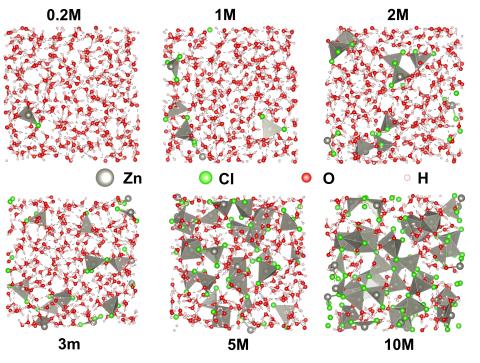
For all selected configurations, single-point calculations of the total energies and atomic forces were performed within density functional theory using the CP2K Quickstep module. Reference calculations employed the revPBE-D3 and r2SCAN exchange-correlation functionals. Motivated by recent work on aqueous Zn²⁺, the main revPBE calculations omitted D3 dispersion contributions involving Zn²⁺, while retaining the D3 correction for water and chloride. For comparison, fully dispersion-corrected revPBE-D3 reference calculations were also performed, with D3 applied to all species, including Zn²⁺. Valence electrons were treated explicitly, while core electrons were represented using norm-conserving Goedecker–Teter–Hutter pseudopotentials. The wave functions were expanded using the mixed Gaussian-and-plane-wave scheme with TZV2P-MOLOPT basis sets for all elements and a 600 Ry auxiliary plane-wave cutoff for the electron density. Self-consistent-field convergence was accelerated using the orbital-transformation and Direct Inversion in the Iterative Subspace algorithms, with a convergence threshold of 10⁻⁶. All single-point calculations were performed in periodic orthorhombic cells. The CELL_REF keyword in CP2K was used to define a fixed reference cell with a box length of 25 Å. This treatment ensured a consistent reference for configurations extracted from NpT trajectories with fluctuating cell dimensions. The resulting DFT energies and atomic forces constitute the ground-truth labels used to train the MLIPs. The resulting MLIP was trained for aqueous ZnCl2 solutions spanning concentrations from 0 to 30 molal and a broad pH range, from strongly acidic to strongly basic conditions. Representative examples of configurations included in the MLIP training dataset are provided below. These include 1) Representative configurations from the dataset labeled at the revPBE-D3 level, with D3 dispersion interactions involving Zn2+ excluded (revPBE-wo-D3). 2) Representative configurations from the dataset labeled at the fully dispersion-corrected revPBE-D3 level, with D3 interactions applied to all species, including Zn2+ (revPBE-D3). 3) Representative configurations from the dataset labeled at the r2SCAN level of theory (r2SCAN).
Sample input files for aqueous zinc chloride are also provided for running ab initio molecular dynamics (AIMD), machine-learning interatomic potential molecular dynamics (MLIP-MD), and classical molecular dynamics simulations, including representative CP2K and LAMMPS setups.
M. Dinpajooh, J. Chen, and L. D. Gibson, Pacific Northwest National Laboratory, Richland, Washington, USA