

Category
Description
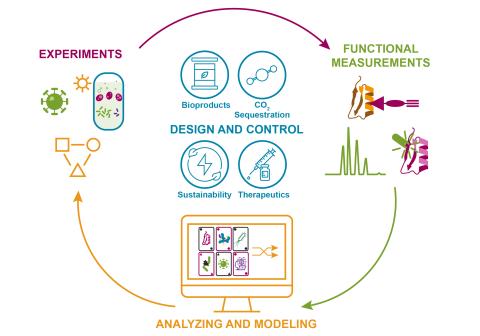
The overarching goal of this research is to predict and engineer robust microbial phenotypes under stressed conditions to accelerate and de-risk bioprocess development.
Laboratory strains routinely fail to maintain productivity at industrial scales, in part due to bioprocess stresses and a limited understanding of microbial stress responses. However, there are limited datasets examining the effects of oscillating stress on phenotypic outcomes during fermentation and few attempts to predict and engineer improved phenotypes. Systematic methods for understanding microbial responses to relevant bioprocess stresses and predictions of critical cellular components that can be tuned are needed to tackle the challenge of robust strain development.
Specifically, this project will develop and implement experimental procedures to assess and modulate microbial stress responses during bioprocess operations. The project will collaborate with the PPI project "VAriation-Leveraged Phenomic Association Study (VaLPAS) to Explore Molecular Dark Matter".
This work has two specific aims:
1. To identify the unique microbial responses to oscillating bioprocess (i.e., environmental) stresses, with the hypothesis that long-term stress responses to oscillating conditions are unique compared to consistently stressed conditions.
2. To modulate the critical components of stress responses through genetic overexpression, activation/inhibition, or deletion to improve strain robustness to oscillating conditions, with a hypothesis that dampening or enhancing certain stress responses will result in more robust bioprocess strains. Overall, this work aims to enable more rapid and de-risked deployment of laboratory strains to commercial scale.
Funding Acknowledgments
The research data described here was funded by the Predictive Phenomics Science & Technology Initiative (PPI), conducted under the Laboratory Directed Research and Development Program, at Pacific Northwest National Laboratory (PNNL). PNNL is a multiprogram national laboratory, operated by Battelle, U.S. Department of Energy, Office of Science under Award Number DE-AC05-76RL01830.
Citation Policy
In efforts to enable discovery, reproducibility, and reuse of PPI-funded project dataset citations in accordance with best practices (e.g., FORCE11 Data and Software Citation Principles), we ask that all reuse of project data packages and linked materials acknowledge all primary and secondary dataset citations, source code citations, and corresponding peer-reviewed journal articles where applicable.
Data Licensing