
Category
Description
Problem Statement and Objectives:
Climate datasets are available across many institutions. Understanding which one to use, or how to combine the datasets, and for which application, or/and which region, and/or which specific fundamental science question is a challenge. A multi-lab PNNL-ANL benchmark on power-system-relevant climate-hydro datasets is needed.
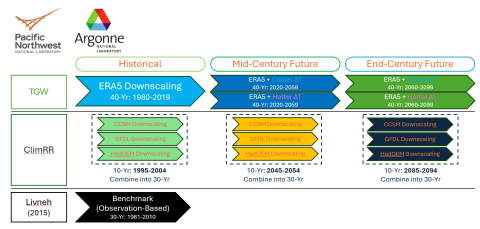
Both ANL and PNNL climate datasets are widely used to evaluate the regional impacts of future climate extremes, yet they differ structurally in how they represent future changes. The TGW approach (delta from GCM forcing an RCM) preserves historical weather sequences while modifying thermodynamic states, whereas ClimMRR (GCMs provide radiation-forcing boundaries to an RCM) allows circulation changes inherent to various GCMs. These structural differences have direct implications for diagnosing changes in future drought characteristics, such as intensity, duration, and frequency, as well as for generating extreme drought events. However, these structural differences are often overlooked when interpreting future drought projections.
Method:
In this PNNL-ANL collaborative effort we:
- develop end-to-end workflows translating two major climate datasets (ClimRR[1]); and TGW[2] ) into hydropower and power system relevant datasets,
- harmonize the datasets with respect to the Livneh et al. [3] gridded observation dataset for a consistent super-ensemble.
- analyze watershed-centric metrics that characterize extreme events across a diversity of drivers (e.g., NIDIS drought metrics) and impact quantification (e.g., generation loss, grid resilience, non-power services)
- demonstrate how structurally different datasets can be used to evaluate drought events.
Impact:
- understand how each modeling approach constrains the generation of drought events and extreme characteristics
- holistic characterization of extreme events and associated uncertainties across CONUS.
- guidance for selecting drought event to inform resource adequacy studies
Organization of the dataset so you can find what you need:
Data are organized according to three primary datasets:
- ClimRR,
- TGW,
- Livneh (baseline data against which ClimRR and TGW are compared)
Each dataset contains CONUS-wide gridded datasets that include historical, mid-century and end-century data. Analysis evolves from the raw climate data to the resultant hydrology, and hydropower production. Included are both the related workflows and output. A fourth dataset includes datasets supporting the comparative drought analysis.
Dataset Suggested Citation
Son, Y., Voisin, V., Tidwell, V., et al. PNNL-ANL Hydrometeorological Super Ensemble. PNNL Datahub (2025), https://doi.org/...
Datasets are published according to four separate DOIs. The corresponding links to the datasets can be accessed here or through the dataset link below.
- Meteorological and Hydrological Drought Analysis Datasets for Livneh, ClimRR, and TGW: https://data.pnnl.gov/group/nodes/dataset/34400 (DOI: https://doi.org/10.25584/3016898)
- TGW Hydrology, River Routing, and Hydropower Simulation Datasets: https://data.pnnl.gov/group/nodes/dataset/34399 (DOI: https://doi.org/10.25584/3016899)
- ClimRR Hydrology, River Routing, and Hydropower Simulation Datasets: https://data.pnnl.gov/group/nodes/dataset/34398 (DOI: https://doi.org/10.25584/3016897)
- Livneh Hydrology, River Routing, and Hydropower Simulation Datasets: https://data.pnnl.gov/group/nodes/dataset/34397 (DOI: https://doi.org/10.25584/3016895)
References
[1] https://climrr.anl.gov/climrrdata
[2] https://tgw-data.msdlive.org/
[3] https://www.nature.com/articles/sdata201542
Team and sponsor
PNNL Team: Vince Tidwell, Nathalie Voisin, Youngjun Son, Cameron Bracken, Goutam Konapala
ANL Team: Neal Mann, Connor Aghili, Rao Kotamarthi
Funding: USDOE Water Power Technologies Office