
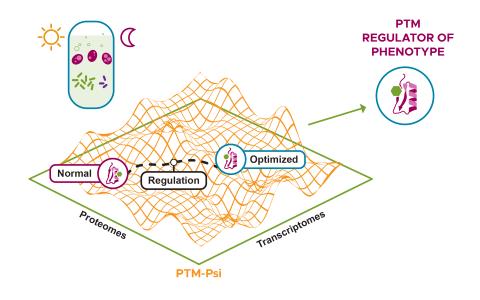
Description
Dataset Description
The goal of this experiment was to investigate the effect of circadian regulation on sucrose production in Synechococcus elongatus PCC 7942. S. elongatus cultures were first trained to light-dark cycles for several days. The synchronized cultures were divided to enable parallel sampling for the first two 8-hour periods: subjective day (12:00-20:00) and subjective night (20:00-04:00). For both conditions, samples were collected throughout the 8-hour experimental period, with time 0 corresponding to the start of each period (12:00 for subjective day and 20:00 for subjective night). Sucrose production, biomass (OD750), cell number, and glycogen content were monitored at hours 0, 0.5, 1, 2, 4, 6, and 8. For transcriptome analysis, samples were collected at hours 0, 2, 4, and 8. Both conditions were maintained under continuous light.
Accessible Digital Data Downloads
The repository contains the following files:
- PB-DP3_SampleMetadata.xlsx: Sample names, experimental conditions, and sampling information.
- PB-DP3_TranscriptomicsExpressionData.xlsx: Raw and normalized transcript counts, along with logfold change and differential expression statistics.
- PB-DP3_ProteomicsExpressionData.xlsx: Normalized protein abundances, statistical comparisons between groups, and annotations for global and PTM proteomics analyses.
- PB-DP3_MetabolomicsExpressionData.xlsx: Sucrose quantification results.
Total Download Size: 11 MB, zipped
Linked Publications
- Gilliam, A, NC Sadler, X Li, M Garcia, Z Johnson, M Velickovic, TM Kim, S Feng, WJ Qian, MS Cheung and P Bohutskyi. 2025. “Cyanobacterial circadian regulation enhances bioproduction under subjective nighttime through rewiring of carbon partitioning dynamics, redox balance orchestration, and cell cycle modulation.” Microbial Cell Factories 24, 56. https://doi.org/10.1186/s12934-025-02665-5
- Kim H, S Feng, P Bohutskyi, X Li, D Mejia-Rodriguez, T Zhang, W Qian, and MS Cheung. 2026. "Thiol post-translational modifications modulate allosteric regulation of the OpcA-G6PDH complex through conformational gate control." Protein Science 35, no. 5:e70561. http://dx.doi.org/10.1002/pro.70561
Linked Primary Data
Raw RNA-seq data for this experiment is available at NCBI GEO under accession GSE288532.
Raw mass spectrometry data for this experiment is available on MassIVE under the following accessions:
MSV000096722, extracellular metabolomics
MSV000099892, proteomics - TMT global and redox PTMs*
MSV000101402, proteomics - phosphorylation and acetylation PTMs
* Previously published as MC-DP3 at this URL.
Funding Acknowledgments
The research data described here was funded in whole or in part by the Predictive Phenomics Initiative (PPI) at Pacific Northwest National Laboratory (PNNL). This work was conducted under the Laboratory Directed Research and Development Program at PNNL. A portion of this research was performed in the Environmental Molecular Sciences Laboratory, a national scientific user facility sponsored by the U.S. Department of Energy (DOE) Office of Science located at PNNL. PNNL is a multiprogram national laboratory operated by Battelle for the DOE under Contract No. DE-AC05-76RL01830.
Citation Policy
In efforts to enable discovery, reproducibility, and reuse of PPI-funded project dataset citations in accordance with best practices (as outlined by the FORCE11 Data Citation Principles), we ask that all reuse of project data and metadata download materials acknowledge all primary and secondary dataset citations and corresponding journal articles where applicable.
Data Licensing
Projects (3)
People (2)