Last updated on 2024-02-11T22:41:43+00:00 by LN Anderson MERS-CoV Experiment MCL001 The purpose of this experiment was to evaluate the human host response to wild-type Middle Eastern Respiratory Syndrome coronavirus (MERS-CoV), and mutants icMERS-CoV-RFP, icMERS-CoV-dNSP16, icMERS-CoV-d4B, and...
Filter results
Category
- (-) Human Health (113)
- (-) Microbiome Science (50)
- Scientific Discovery (401)
- Biology (285)
- Earth System Science (166)
- Integrative Omics (96)
- National Security (32)
- Computational Research (25)
- Computing & Analytics (18)
- Energy Resiliency (13)
- Chemical & Biological Signatures Science (12)
- Weapons of Mass Effect (12)
- Materials Science (11)
- Chemistry (10)
- Data Analytics & Machine Learning (9)
- Computational Mathematics & Statistics (7)
- Data Analytics & Machine Learning (7)
- Renewable Energy (7)
- Atmospheric Science (6)
- Ecosystem Science (6)
- Visual Analytics (6)
- Coastal Science (4)
- Energy Storage (4)
- Plant Science (4)
- Solar Energy (4)
- Bioenergy Technologies (3)
- Energy Efficiency (3)
- Transportation (3)
- Cybersecurity (2)
- Distribution (2)
- Electric Grid Modernization (2)
- Grid Cybersecurity (2)
- Subsurface Science (2)
- Wind Energy (2)
- Advanced Lighting (1)
- Computational Mathematics & Statistics (1)
- Environmental Management (1)
- Federal Buildings (1)
- Geothermal Energy (1)
- Grid Analytics (1)
- Grid Energy Storage (1)
- High-Performance Computing (1)
- Terrestrial Aquatics (1)
- Vehicle Technologies (1)
- Waste Processing (1)
- Water Power (1)
Tags
- Virology (77)
- Immune Response (51)
- Time Sampled Measurement Datasets (51)
- Differential Expression Analysis (46)
- Gene expression profile data (45)
- Homo sapiens (42)
- Mass spectrometry data (32)
- Multi-Omics (31)
- Viruses (24)
- Health (23)
- Virus (23)
- MERS-CoV (19)
- Mus musculus (18)
- West Nile virus (13)
- Omics (12)
- Influenza A (11)
- Predictive Phenomics (10)
- Ebola (9)
- High Throughput Sequencing (9)
- Mass Spectrometry (9)
- PerCon SFA (9)
- Genomics (7)
- Microarray (7)
- Type 1 Diabetes (7)
- HCoV-299E (6)
- Human Interferon (6)
- Machine Learning (6)
- Omics-LHV Project (6)
- Proteomics (6)
- Resource Metadata (6)
Last updated on 2024-02-11T22:41:43+00:00 by LN Anderson Interferon Experiment IFNaHUH001 The purpose of this experiment was to evaluate the human host cellular response to treatment with and without interferon alpha/beta (IFNα/β) treatment. Sample time course data was obtained from human hepatoma...
Category
Last updated on 2024-02-11T22:41:43+00:00 by LN Anderson Interferon Experiment IFNMVE001 The purpose of this experiment was to evaluate the human host interferon-stimulated cellular response to interferon alpha/beta (IFNαβ) or gamma (INFγ) treatment. Sample data was obtained from primary lung...
Category
Last updated on 2024-02-11T22:41:43+00:00 by LN Anderson Interferon Experiment IFNFB001 The purpose of this experiment was to evaluate the human host cellular response to interferon alpha/beta (IFNα/β) or interferon gamma (IFNγ) treatment. Sample data was obtained from primary human lung fibroblast...
Category
Last updated on 2024-02-11T22:41:43+00:00 by LN Anderson Interferon Experiment IFNaIHH001 The purpose of this experiment was to evaluate the host interferon-stimulated cellular response to interferon alpha (IFNα) treatment. Sample data was obtained from human immortalized human hepatocyte cells (IHH...
Category
Last updated on 2024-02-11T22:41:43+00:00 by LN Anderson Interferon Experiment IFNaCL001 The purpose of this experiment was to evaluate the host interferon-stimulated cellular response to interferon alpha (IFNα) treatment. Sample data was obtained from human lung adenocarcinoma cells (Calu-3)...
Category
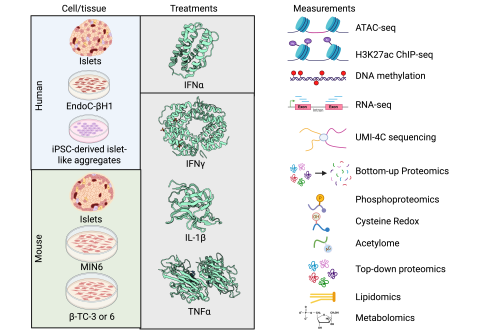
Background In type 1 diabetes (T1D), autoimmune response and inflammation cause the death of pancreatic β cells, leading to the body’s inability to produce insulin and maintain glucose homeostasis. This process is at least in part mediated by pro-inflammatory cytokines, such as interferon (IFN)α...
Category
Datasets
21
Coronaviruses (CoV) emerge suddenly from animal reservoirs to cause novel diseases in new hosts. Discovered in 2012, the Middle East respiratory syndrome coronavirus (MERS-CoV) is endemic in camels in the Middle East and is continually causing local outbreaks and epidemics. While all three newly...
Category
The ability of high-density lipoprotein (HDL) to promote cellular cholesterol efflux is a more robust predictor of cardiovascular disease protection than HDL-cholesterol levels in plasma. Previously, we found that lipidated HDL containing both apolipoprotein A-I (APOA1) and A-II (APOA2) promotes...
Category
"Moisture modulates soil reservoirs of active DNA and RNA viruses" Soil is known to harbor viruses, but the majority are uncharacterized and their responses to environmental changes are unknown. Here, we used a multi-omics approach (metagenomics, metatranscriptomics and metaproteomics) to detect...
Two factors that are well-known to influence soil microbiomes are the depth of the soil as well as the level of moisture. Previous works have demonstrated that climate change will increase the incidence of drought in soils, but it is unknown how fluctuations in moisture availability affect soil...
Category
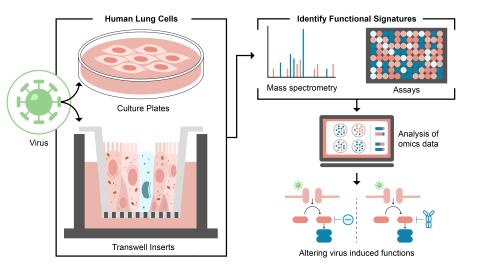
The research goal of this project is to identify and control host functions hijacked during viral infection through use of PNNL ‘omics technologies and modeling capabilities.
Datasets
5
The Human Islet Research Network (HIRN) is a large consortia with many research projects focused on understanding how beta cells are lost in type 1 diabetics (T1D) with a goal of finding how to protect against or replace the loss of functional beta cells. The consortia has multiple branches of...
Category
Datasets
1
Predictive Phenomics Initiative (PPI) Project Data Catalog Collection The Predictive Phenomics Initiative (PPI) is an internal LDRD investment at Pacific Northwest National Laboratory focused on unraveling the mysteries of molecular function in complex biological systems. Explore PPI research...
Category
Datasets
17
Human infections caused by viral pathogens trigger a complex gamut of host responses that limit disease, resolve infection, generate immunity, and contribute to severe disease or death. Here, we present experimental methods and multi-omics data capture approaches representing the global host...