Last updated on 2024-02-11T22:41:43+00:00 by LN Anderson Interferon Experiment IFNMVE001 The purpose of this experiment was to evaluate the human host interferon-stimulated cellular response to interferon alpha/beta (IFNαβ) or gamma (INFγ) treatment. Sample data was obtained from primary lung...
Filter results
Category
- (-) Integrative Omics (96)
- (-) Microbiome Science (50)
- Scientific Discovery (406)
- Biology (287)
- Earth System Science (169)
- Human Health (113)
- National Security (32)
- Computational Research (25)
- Computing & Analytics (18)
- Energy Resiliency (16)
- Chemical & Biological Signatures Science (12)
- Weapons of Mass Effect (12)
- Materials Science (11)
- Chemistry (10)
- Data Analytics & Machine Learning (9)
- Renewable Energy (8)
- Computational Mathematics & Statistics (7)
- Data Analytics & Machine Learning (7)
- Atmospheric Science (6)
- Ecosystem Science (6)
- Visual Analytics (6)
- Coastal Science (4)
- Energy Storage (4)
- Plant Science (4)
- Solar Energy (4)
- Bioenergy Technologies (3)
- Energy Efficiency (3)
- Transportation (3)
- Cybersecurity (2)
- Distribution (2)
- Electric Grid Modernization (2)
- Grid Cybersecurity (2)
- Subsurface Science (2)
- Water Power (2)
- Wind Energy (2)
- Advanced Lighting (1)
- Computational Mathematics & Statistics (1)
- Environmental Management (1)
- Federal Buildings (1)
- Geothermal Energy (1)
- Grid Analytics (1)
- Grid Energy Storage (1)
- High-Performance Computing (1)
- Terrestrial Aquatics (1)
- Vehicle Technologies (1)
- Waste Processing (1)
Tags
- Virology (55)
- Immune Response (51)
- Time Sampled Measurement Datasets (50)
- Differential Expression Analysis (46)
- Gene expression profile data (45)
- Homo sapiens (34)
- Multi-Omics (32)
- Mass spectrometry data (31)
- Mus musculus (19)
- MERS-CoV (18)
- Omics (18)
- West Nile virus (13)
- Mass Spectrometry (12)
- Influenza A (11)
- Ebola (9)
- PerCon SFA (9)
- High Throughput Sequencing (8)
- Genomics (7)
- Proteomics (7)
- Resource Metadata (7)
- Human Interferon (6)
- Microarray (6)
- Omics-LHV Project (6)
- Imaging (5)
- Sequencer System (5)
- Soil Microbiology (5)
- Synthetic Biology (5)
- Mass Spectrometer (4)
- metabolomics (4)
- Microscopy (3)
Last updated on 2024-02-11T22:41:43+00:00 by LN Anderson Interferon Experiment IFNFB001 The purpose of this experiment was to evaluate the human host cellular response to interferon alpha/beta (IFNα/β) or interferon gamma (IFNγ) treatment. Sample data was obtained from primary human lung fibroblast...
Category
Last updated on 2024-02-11T22:41:43+00:00 by LN Anderson Interferon Experiment IFNaIHH001 The purpose of this experiment was to evaluate the host interferon-stimulated cellular response to interferon alpha (IFNα) treatment. Sample data was obtained from human immortalized human hepatocyte cells (IHH...
Category
Last updated on 2024-02-11T22:41:43+00:00 by LN Anderson Interferon Experiment IFNaCL001 The purpose of this experiment was to evaluate the host interferon-stimulated cellular response to interferon alpha (IFNα) treatment. Sample data was obtained from human lung adenocarcinoma cells (Calu-3)...
Category
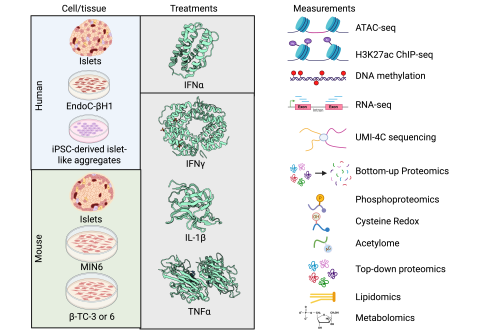
Background In type 1 diabetes (T1D), autoimmune response and inflammation cause the death of pancreatic β cells, leading to the body’s inability to produce insulin and maintain glucose homeostasis. This process is at least in part mediated by pro-inflammatory cytokines, such as interferon (IFN)α...
Category
Datasets
21
"Moisture modulates soil reservoirs of active DNA and RNA viruses" Soil is known to harbor viruses, but the majority are uncharacterized and their responses to environmental changes are unknown. Here, we used a multi-omics approach (metagenomics, metatranscriptomics and metaproteomics) to detect...
Two factors that are well-known to influence soil microbiomes are the depth of the soil as well as the level of moisture. Previous works have demonstrated that climate change will increase the incidence of drought in soils, but it is unknown how fluctuations in moisture availability affect soil...
Category
Predictive Phenomics Initiative (PPI) Project Data Catalog Collection The Predictive Phenomics Initiative (PPI) is an internal LDRD investment at Pacific Northwest National Laboratory focused on unraveling the mysteries of molecular function in complex biological systems. Explore PPI research...
Category
Datasets
18
A major challenge in biotechnology and biomanufacturing is the identification of a set of biomarkers for perturbations and metabolites of interest. Here, we develop a data-driven, transcriptome-wide approach to rank perturbation-inducible genes from time-series RNA sequencing data for the discovery...
The rhizosphere represents a dynamic and complex interface between plant hosts and the microbial community found in the surrounding soil. While it is recognized that manipulating the rhizosphere has the potential to improve plant fitness and health, engineering the rhizosphere microbiome through...
Agriculture is the largest source of greenhouse gases (GHG) production. Conversion of nitrogen fertilizers into more reduced forms by microbes through a process known as biological nitrification drives GHG production, enhances proliferation of toxic algal blooms, and increases cost of crop...
Metabolite exchange between plant roots and their associated rhizosphere microbiomes underpins plant growth promotion by microbes. Sorghum bicolor is a cereal crop that feeds animals and humans and is used for bioethanol production. Its root tips exude large amounts of a lipophilic benzoquinone...
The Sequel II System Sequencer is a high-throughput DNA sequencer machine developed and manufactured by PacBio , and is designed for high throughput, production-scale sequencing laboratories. Originally released in 2015, the Sequel system provides Single Molecule, Real-Time (SMRT) sequencing core...
Short Biography Caroline (Carrie) Harwood received her Ph.D. in microbiology from the University of Massachusetts and completed postdoctoral work at Yale University. She held academic appointments at Cornell University and the University of Iowa before moving to the University of Washington in 2005...
Category
Biography Kristin Burnum-Johnson is a senior scientist and team lead of the Biomolecular Pathways team at PNNL. Burnum-Johnson earned her PhD in Biochemistry from Vanderbilt University with Professor Richard M. Caprioli and then completed a postdoctoral fellowship at PNNL with Dr. Richard D. Smith...